How to Track Muscle Recovery Between Workouts
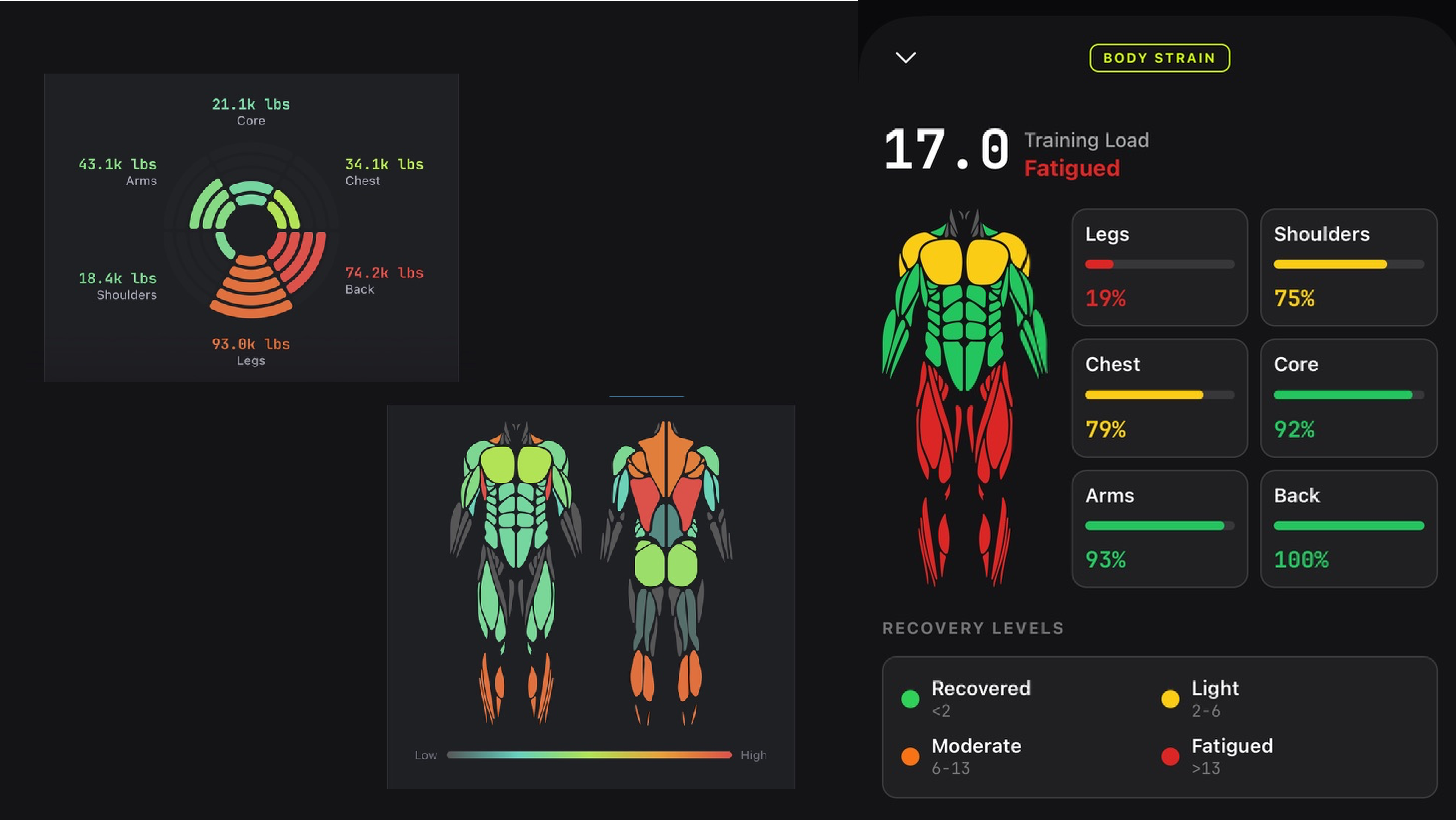
You track your sets, your reps, your weight on the bar. Maybe you even track RPE or total volume. But odds are you're not tracking recovery — and it's costing you gains.
Here's what that looks like in practice. You walk into the gym on leg day. Quads are still cooked from Thursday. You squat anyway because it's Monday and Monday is squat day. The weight feels heavier than it should. You grind through it, but the numbers are down. You chalk it up to a bad day.
It wasn't a bad day. Your quads weren't ready. You just didn't have a way to know that.
How muscle recovery actually works
When you train hard, you create micro-damage in the muscle fibers. Your body repairs that damage and builds the tissue back stronger — exercise scientists call this supercompensation. The catch is timing. Train before the repair is done and you're digging a hole. Wait too long after repair and you've missed the window.
For most people, the repair timeline looks roughly like this:
- Biceps and triceps: 24–48 hours
- Chest, back, and shoulders: 48–72 hours
- Legs and lower back (especially after heavy squats or deadlifts): 72–96 hours, sometimes longer
But those are averages, and averages lie. Your actual recovery depends on how many sets you did, how close to failure you went, whether you used intensity techniques like drop sets or rest-pause, how much you slept, what you ate, and how stressed you are about that deadline at work. Two chest sessions can look identical on paper and create wildly different recovery demands.
Why fixed training splits fall short
Fixed training splits assume recovery is the same every week. It's not. Last Monday you did 14 sets of chest at moderate intensity and slept 8 hours. This Monday you did 20 sets with drop sets on every movement and slept 5 hours because your kid was sick. Your chest doesn't care that it's been exactly 7 days — it cares about the damage it took and the resources it had to repair.
This is the gap most lifters miss. They plan recovery by the calendar when they should be planning it by the data.
Four ways to actually track recovery
There's no blood test for "is my chest recovered." But there are solid proxies you can start using today.
1. Watch your strength trends
This is the simplest method. If your bench press working weight at a given RPE is holding steady or going up, your chest is recovering fine. If it's been slipping for two or three sessions in a row, something's off — usually insufficient recovery time or too much accumulated volume.
2. Pay attention to RPE drift
You know what 135 lbs at RPE 7 feels like on bench. If the same weight suddenly feels like a 9, your chest probably isn't fully recovered. Log RPE honestly per set and you'll start seeing patterns over time.
3. Track volume per muscle group
This is where most people's tracking falls short. They know they did "chest day" but they don't know whether they accumulated 12 sets or 22 sets of chest stimulus that week once you count all the pressing movements across multiple sessions. When you actually add it up, a lot of lifters are doing far more volume than they realize on some muscle groups and not enough on others.
4. Use a strain model
This is the most precise approach. Instead of guessing, you track the total stimulus per muscle group and model how long recovery should take based on that stimulus. Some apps show this as a body heat map — you open the app and immediately see which muscles are still recovering and which ones are fresh. No math, no guesswork, just a visual that tells you what to train today.
Soreness is not a recovery indicator
Soreness is a terrible proxy for recovery and too many lifters put stock in it. You can be fully recovered structurally while still feeling sore — DOMS (delayed onset muscle soreness) often outlasts actual muscle repair by a day or two. And you can feel perfectly fine while still being under-recovered because the damage is at a cellular level you can't feel.
That said, if you're still notably sore 72+ hours after a session, you probably went too hard. That's not a recovery failure — it's a programming one. Dial back the volume or the intensity techniques next time.
Common recovery mistakes
Not sleeping enough. Sleep is when the bulk of muscle protein synthesis happens. Seven hours is the floor, not the goal. No supplement makes up for poor sleep.
Overusing intensity techniques. Drop sets, myo-reps, rest-pause — these create significantly more damage per set than straight sets. If you're tagging these onto every exercise, your recovery demands are much higher than your set count suggests. Use them strategically, not habitually.
Running the same volume year-round. Your recovery capacity changes with life stress, training age, sleep quality, nutrition, and accumulated fatigue. The volume that drove progress in January might be burying you by March. Check the data. Adjust.
Confusing soreness with injury. Sore quads after heavy squats? Normal. Sharp knee pain during squats? That's not recovery — that's an injury signal. Don't push through it.
The bottom line
The lifters who make steady progress year after year aren't the ones training the hardest. They're the ones training at the right time — they know which muscles are ready and which ones need another day. They have data instead of guesses.
Track your volume per muscle group, log RPE honestly, watch your performance trends, and ideally use something that models recovery for you so you can see it at a glance instead of doing mental math between sets.
Your body is constantly telling you what's ready. Start listening.
Slate's muscle recovery tracker uses a visual body heat map to show exactly which muscles are recovered and which need more time — no guesswork, no math between sets. It's free on iOS.
Want to see how different workout tracker apps handle recovery tracking? Check out our 7 Best Workout Tracker Apps in 2026 comparison, or see how Slate stacks up against Hevy and Strong in our detailed comparison guides.
Try the top-ranked workout tracker
Slate combines fast logging, AI workout generation, muscle recovery tracking, and DOTS scoring — free to download.
Download Free for iOS