The RPE Scale for Strength Training, Explained
If you have ever followed a training program that says "3x5 at RPE 8" and wondered what that actually means, you are not alone. The RPE scale is one of the most useful tools in strength training, but it is also one of the most misunderstood.
RPE stands for Rate of Perceived Exertion. In the context of lifting, it is a way to measure how hard a set was based on how close you were to failure — not based on a fixed percentage of your max, but based on how the weight actually felt that day.
Once you understand it, RPE changes how you train. It gives you a framework for knowing when to push harder, when to back off, and how to make real-time decisions instead of blindly following numbers that may not match your body on any given day.
Here is how it works, how to use it, and why it matters more than most lifters think.
What Is the RPE Scale?
The original RPE scale was developed by Swedish researcher Gunnar Borg in the 1960s as a way to measure effort during cardiovascular exercise. It ran from 6 to 20, which was designed to roughly correlate with heart rate.
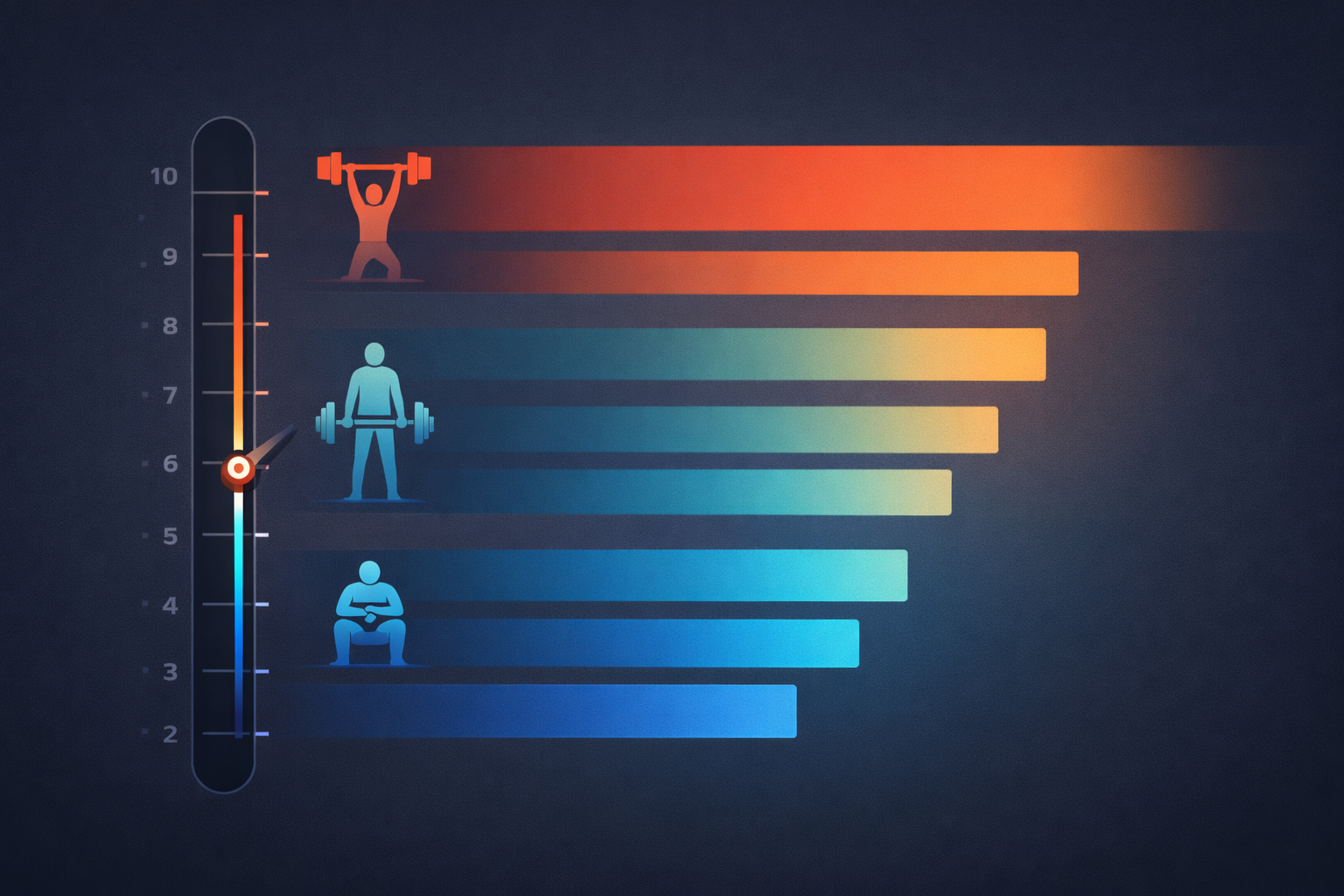
That version is still used in clinical and cardio settings. But for strength training, the community has adopted a modified 1-10 scale, popularized by powerlifter and coach Mike Tuchscherer through his Reactive Training Systems (RTS) method. This version maps RPE directly to "reps in reserve" (RIR) — how many more reps you could have done before hitting failure.
Here is the scale:
| RPE | Reps in Reserve | What It Feels Like |
|---|---|---|
| 10 | 0 | Absolute max effort. Could not have done another rep. |
| 9.5 | 0 | Max effort, but might have had a few more pounds in you. |
| 9 | 1 | Could have done one more rep, maybe. |
| 8.5 | 1-2 | Definitely one more rep, possibly two. |
| 8 | 2 | Two reps left in the tank. Solid working intensity. |
| 7.5 | 2-3 | Two to three reps left. Moderate-hard effort. |
| 7 | 3 | Three reps in reserve. Challenging but controlled. |
| 6 | 4 | Warm-up weight. Speed is fast, effort is moderate. |
| 5 and below | 4+ | Light effort. Technical practice or active recovery. |
The practical range for most training is RPE 6 through 10. Anything below 6 is essentially warm-up territory.
Why RPE Is More Useful Than Percentage-Based Training
Most traditional programs prescribe intensity as a percentage of your one-rep max. Squat 3x5 at 80% of your 1RM. Bench 4x8 at 70%. This approach works, but it has a fundamental problem: it assumes your 1RM is the same every day.
It is not.
Your strength fluctuates based on sleep, stress, nutrition, how recovered you are, whether you slept on your neck wrong, whether you had a fight with someone that morning. Research from Barbell Medicine estimates that daily strength can vary by 5-10% even in trained lifters. That means your "80%" could feel like 75% on a good day and 87% on a bad one.
RPE solves this by making intensity relative to your actual capacity on that specific day.
If the program says "3x5 at RPE 8," you work up to a weight where you finish each set with about two reps left in the tank. On a strong day, that might be 315. On a rough day, it might be 295. Either way, the training stimulus is appropriately matched to what your body can handle right now — not what it could handle the last time you tested your max.
This is called autoregulation, and it is one of the most evidence-supported approaches to long-term strength development. Instead of forcing your body into a fixed number, you adjust the load to match your readiness.
How to Use RPE in Your Workouts
Using RPE is straightforward once you have calibrated your internal effort gauge. Here is a practical approach.
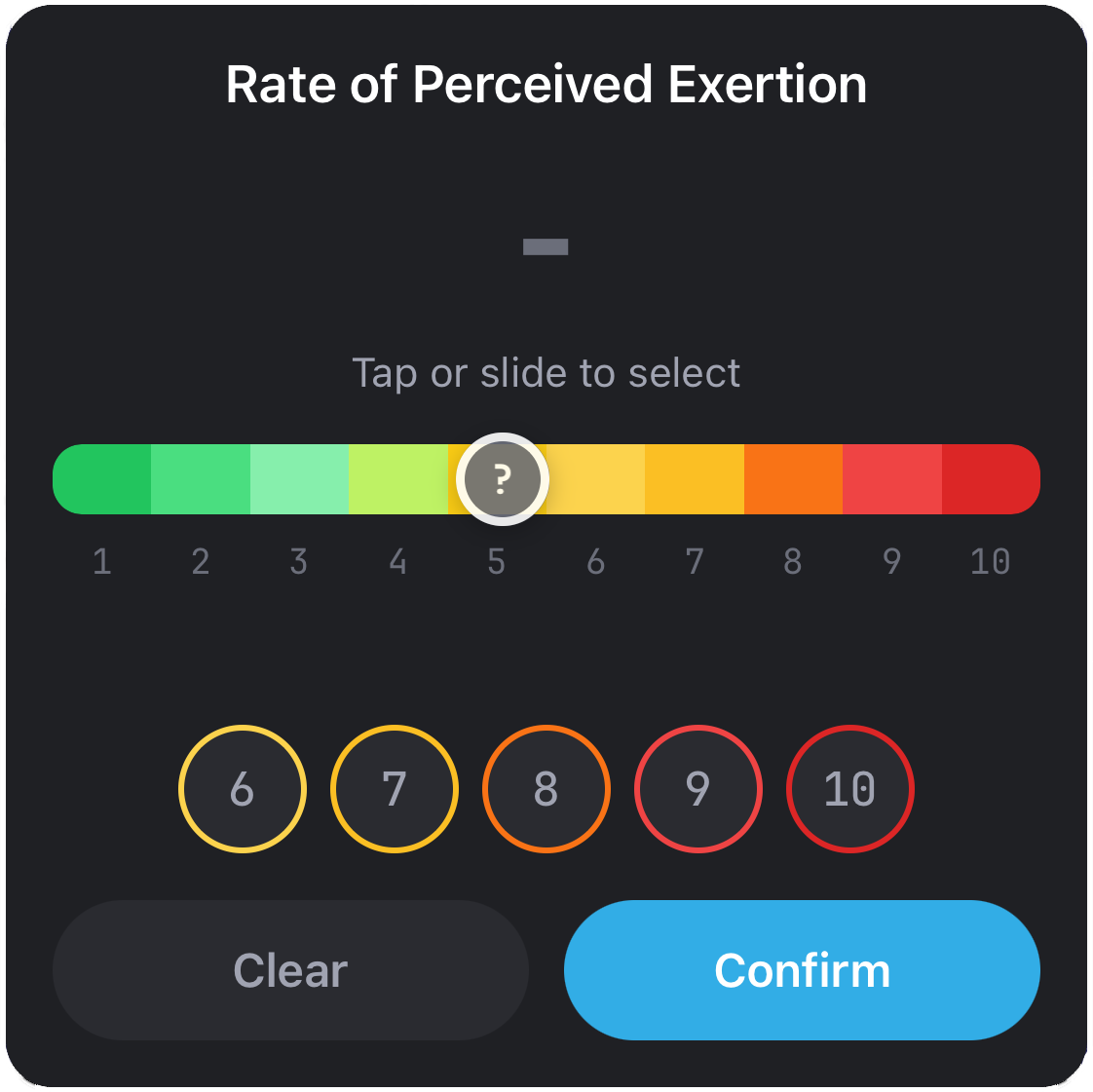
Start with your warm-ups. As you ramp up to your working weight, pay attention to how each set feels. Your last warm-up set should be around RPE 5-6 — moderate effort, fast bar speed, no grind. This gives you a reference point for the day.
Hit your working sets by feel. If the program calls for 3x5 at RPE 8, load a weight you think will leave you with about two reps in the tank after five. If the first set felt like RPE 7, add weight. If it felt like RPE 9, drop it. The goal is to hit the target RPE, not a target weight.
Log the RPE alongside the weight. This is where tracking matters. Writing down "Squat: 305 x 5 @ RPE 8" gives you a data point that is far more useful than just "305 x 5." Over time, you can see trends — if 305 x 5 was RPE 8 last month and RPE 7 this month, you are getting stronger. That is progressive overload you can actually see.
Adjust within the session. RPE is not just for set-to-set decisions. If your third set of squats felt like RPE 9.5 when it should have been 8, that is your body telling you something. Drop the weight for the remaining sets or cut the session short. Ignoring these signals is how injuries happen and how recovery debt accumulates.
RPE by Exercise Type
Not all exercises deserve the same RPE treatment. Here is a practical framework.
Compound barbell lifts (squats, deadlifts, bench, overhead press): Train at RPE 7-9 for most working sets. These movements generate the most systemic fatigue and carry the highest injury risk at near-max effort. Pushing every set to RPE 10 on compounds is a recipe for burnout and overuse injuries. Save RPE 9.5-10 for testing days or competition.
Compound accessory lifts (rows, pull-ups, lunges, dips): RPE 7.5-9 is the sweet spot. These are important movements but the fatigue cost is lower than the main barbell lifts, so you can push a bit closer to failure.
Isolation exercises (curls, lateral raises, tricep extensions, calf raises): RPE 8-10 is appropriate. The injury risk is low, the recovery cost is minimal, and the hypertrophy stimulus from these exercises depends heavily on proximity to failure. Going to RPE 10 on a set of curls is fine. Going to RPE 10 on a set of heavy deadlifts is a very different decision.
Common RPE Mistakes
Mistake 1: Always training at RPE 10. If every set is a max-effort grind, you are leaving recovery on the table and limiting your weekly volume capacity. Research consistently shows that training 1-3 reps from failure produces nearly identical hypertrophy and strength gains to training to failure — with significantly less fatigue. Most of your training should live at RPE 7-9.
Mistake 2: Sandbagging RPE. The opposite problem. Some lifters chronically underrate their RPE, calling sets "RPE 8" when they had four or five reps left. If you are never uncomfortable during your working sets, your RPE calibration is off. Film your sets occasionally and count the actual reps to failure on a test set to recalibrate.
Mistake 3: Ignoring RPE on bad days. The whole point of autoregulation is that you adjust. If the weight that was RPE 7 last week feels like RPE 9 today, the right move is to reduce the load and hit the prescribed RPE — not to ego-lift through it because the spreadsheet says so.
Mistake 4: Using RPE without logging it. RPE only becomes powerful when you track it over time. A single RPE rating tells you almost nothing. But three months of RPE data next to your weights and reps tells you exactly how your strength is trending, when you are accumulating too much fatigue, and when you are ready to push. This is why a workout tracker app that supports RPE logging is so much more useful than one that only tracks weight and reps.
RPE and Recovery: The Connection Most People Miss
Here is where RPE gets really interesting — and where most articles about it stop short.
RPE is not just an intensity tool. It is a recovery signal.
If your squat has been consistently RPE 8 at 315 for the past three weeks, and this week it suddenly feels like RPE 9.5 at the same weight, something is off. Maybe you slept badly. Maybe you are under-eating. Or maybe the cumulative fatigue from your training has caught up with you and your body needs a deload.
This is why tracking RPE alongside muscle strain and recovery data is so powerful. RPE tells you how a set felt subjectively. Recovery tracking tells you how your muscles are doing objectively — how much volume they have absorbed, how long they have had to recover, and which muscle groups are fresh versus fatigued.
When you combine both signals, you stop guessing. You can see that your quads have taken heavy volume three sessions in a row, your RPE on squats has been creeping up each session, and the smart move is a lighter leg day or an upper body focus. That is training with intelligence instead of just training with effort.
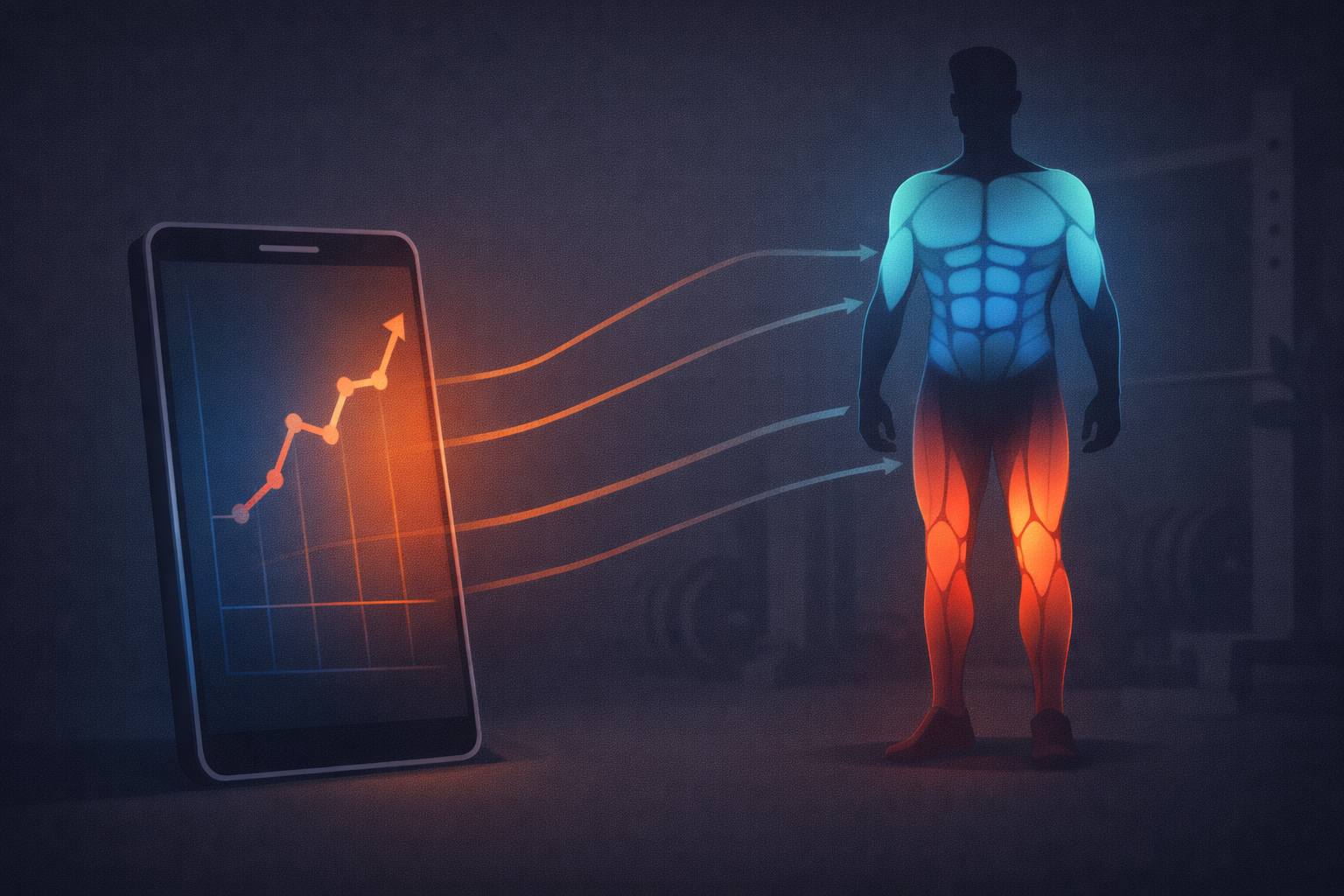
Slate tracks RPE on every set and feeds it directly into the muscle strain and recovery model. When you log a set at RPE 9, Slate knows that set created more fatigue than the same weight at RPE 7 — and the recovery timeline adjusts accordingly. Open the app the next day and the body heat map shows you exactly which muscles are still recovering and which are ready for work. No spreadsheets, no mental math, no "chest Monday" regardless of what your body is telling you.
You can also use voice logging to dictate sets with RPE included — say "squat 315 for 5, RPE 8" and Slate captures the full picture. Check your DOTS score to see how your RPE-adjusted training is translating to real strength gains relative to your body weight.
If you are switching from Hevy or Strong, Slate imports your full history so your RPE trends carry over from day one.
How to Start Using RPE Today
If you have never used RPE, here is the simplest way to start.
Week 1-2: At the end of every working set, ask yourself: "How many more reps could I have done?" Write down the answer as an RPE rating next to your set. Do not change your programming yet — just start building awareness.
Week 3-4: Start using RPE to make small adjustments. If a set felt easier than intended (RPE 6-7 when it should be 8), add 5-10 pounds. If it felt harder (RPE 9-10 when it should be 8), drop 5-10 pounds for the next set.
Week 5 and beyond: You should have enough data to see patterns. Are your RPEs creeping up over time at the same weight? You might need a deload. Are they dropping? Time to push the load up. This is autoregulation in practice, and it works.
The key is consistency. RPE is a skill that improves with practice. The more sets you rate, the better your internal gauge becomes. Most lifters develop reliable RPE accuracy within 4-6 weeks.
Slate tracks every set, maps muscle strain and recovery, and generates AI-powered workouts from plain language — so you spend less time planning and more time progressing. Download Slate free on the App Store.
Track Every Set. See Every Gain.
Slate tracks every set, maps muscle strain and recovery, and generates AI-powered workouts from plain language — so you spend less time planning and more time progressing. Download Slate free on the App Store.
Download Free for iOS